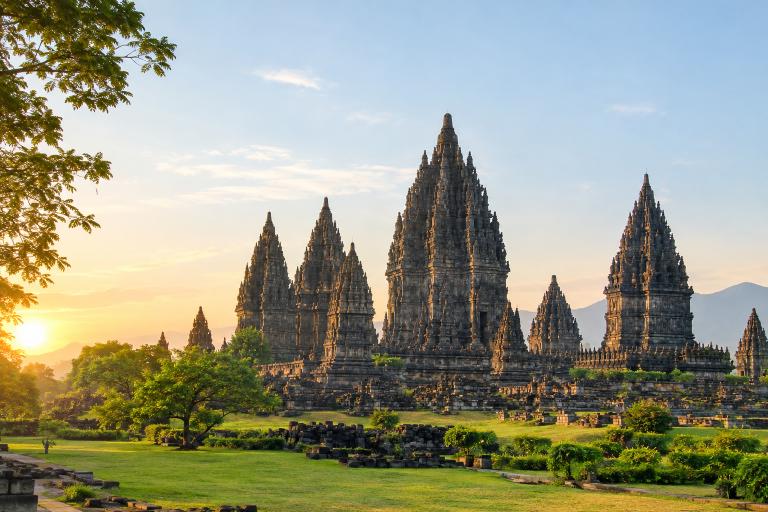
Prambanan Temple is one of the finest examples of Hindu architecture in Southeast Asia. Its towering stone shrines, detailed carvings, and carefully planned layout reflect the artistic skill of ancient Javanese builders. For anyone interested in Prambanan temple architecture, it offers a remarkable example of sacred design and craftsmanship.
Prambanan was built during the 9th century under the Mataram Kingdom. The complex was designed as a major center of Hindu worship and dedicated to the Trimurti: Shiva, Vishnu, and Brahma. The central Shiva Temple is the tallest structure, reaching approximately 47 meters.
The complex contains hundreds of structures arranged in concentric zones. The most sacred buildings stand at the center, while smaller shrines surround them. This layout reflects Hindu cosmology and the idea of a sacred universe centered on divine power.
One of Prambanan’s most striking features is its use of volcanic andesite stone. Builders shaped each block carefully and assembled the structures with impressive precision. This technique demonstrates the advanced engineering knowledge of ancient Javanese craftsmen.
The temple towers, known as candi, feature tall, pointed spires resembling sacred mountains. In Hindu tradition, mountains are associated with the gods. Prambanan’s towers may symbolize Mount Meru, the mythical center of the universe, giving the complex a powerful spiritual appearance.
The main temple walls feature detailed reliefs from the Ramayana epic. These carvings tell the story of Prince Rama, his wife Sita, and the monkey hero Hanuman. They depict loyalty, courage, sacrifice, and the victory of good over evil, offering valuable insight into ancient Javanese culture.
Prambanan is also known as Candi Roro Jonggrang, named after a famous Javanese legend. According to the story, a prince attempted to build one thousand temples in one night. The princess tricked him into believing dawn had arrived, and he transformed her into stone as punishment.
Earthquakes, volcanic activity, and political changes contributed to the temple’s decline. Many structures collapsed, and the site was eventually abandoned. Rediscovered in the 17th century, Prambanan has undergone restoration for decades.
In 1991, Prambanan Temple Compounds became a UNESCO World Heritage Site, recognizing its exceptional architectural and cultural significance. Nearby Buddhist monuments, including Sewu, Lumbung, and Bubrah, demonstrate the religious diversity of ancient Java.
Located approximately 17 kilometers northeast of Yogyakarta city center, Prambanan is easily accessible to travelers. Visitors can combine their trip with attractions such as Borobudur, the Sultan’s Palace, Malioboro Street, and Mount Merapi.
Prambanan also continues to play an important role in preserving Indonesia’s cultural heritage. Visitors can explore the temple grounds, admire the intricate stone reliefs, and learn about the religious traditions that shaped ancient Java. Cultural performances, including the famous Ramayana Ballet, bring these historic stories to life through traditional dance, music, and elaborate costumes. These experiences make Prambanan not only an architectural treasure but also a place where history, art, and living traditions come together.
Prambanan is more than an ancient monument. It represents Indonesia’s history, creativity, and spiritual heritage. Its towering temples, intricate carvings, and sacred atmosphere make it one of Southeast Asia’s most remarkable architectural achievements.