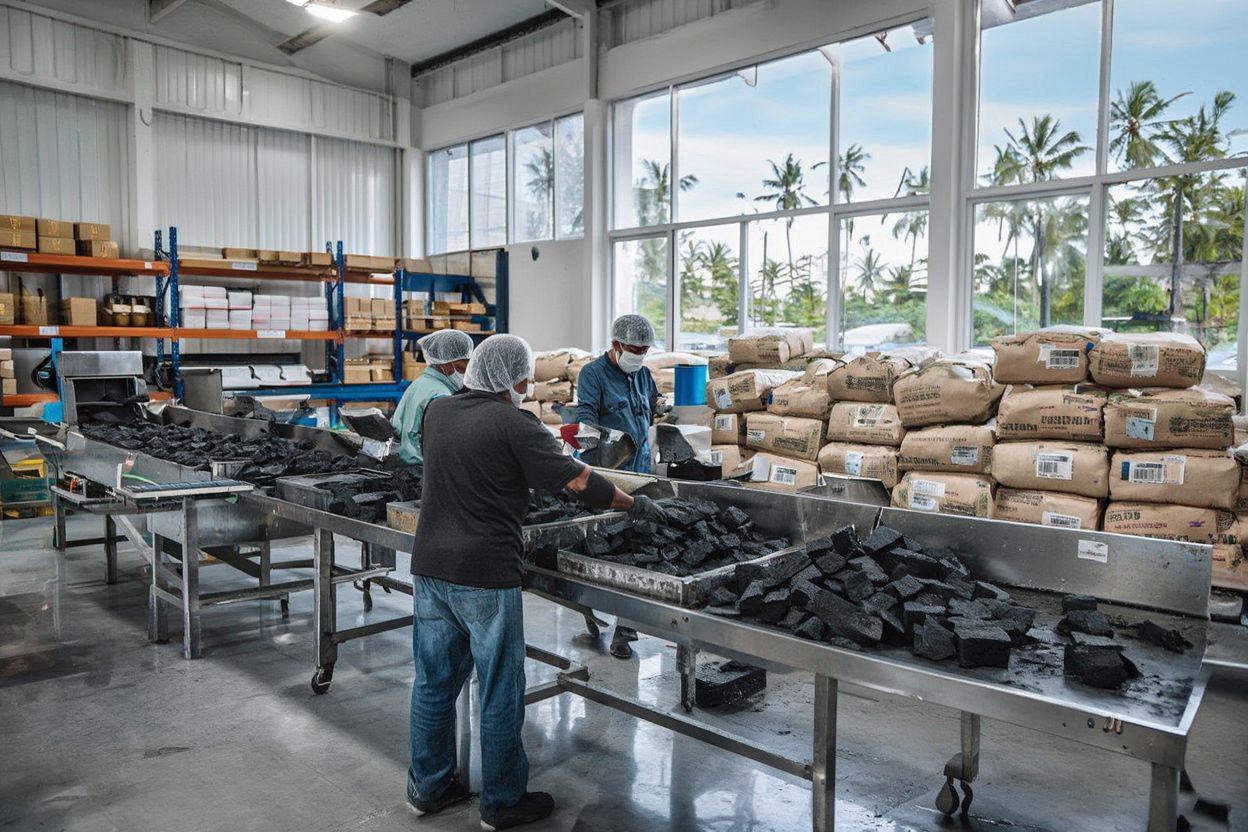
Coconut shell charcoal business Indonesia continues to grow as global demand for sustainable and high performance charcoal increases. Supported by abundant coconut resources and established production networks, Indonesia has become a strategic hub for coconut shell based charcoal businesses serving domestic and international markets.
Rather than relying on hardwood materials, many businesses in Indonesia utilize coconut shells generated from agricultural and food processing activities. Consequently, this approach transforms waste into valuable carbon products while supporting environmentally responsible business practices.
Indonesia’s Position in the Coconut Shell Charcoal Business
Indonesia ranks among the world’s largest coconut producers, ensuring continuous availability of raw materials. Therefore, coconut shell charcoal businesses can operate consistently without major supply disruptions.
In addition, production facilities are often located near coconut processing centers. As a result, transportation costs decrease and raw material quality remains stable throughout the supply chain.
This structural advantage allows Indonesian charcoal businesses to compete effectively in regional and global markets.
Production Process Supporting Business Scalability
The coconut shell charcoal business in Indonesia relies on controlled and scalable production methods. First, producers collect mature coconut shells with suitable density and low moisture content.
Next, the shells undergo cleaning and drying before carbonization. During this stage, manufacturers apply regulated temperatures and limited oxygen exposure to increase fixed carbon levels.
Many business operators follow practices aligned with coconut shell charcoal Indonesia standards to ensure consistent quality, reliable output, and long term business sustainability.
Market Segments Served by Indonesian Charcoal Businesses
Coconut shell charcoal businesses in Indonesia serve diverse market segments. Domestically, suppliers distribute charcoal for household cooking, food service, and small scale industries.
Meanwhile, export oriented businesses supply charcoal to international buyers for barbecue fuel, shisha manufacturing, activated carbon production, and industrial applications.
This market diversity helps businesses reduce dependency on a single sales channel.
Quality Control as a Business Foundation
Quality consistency remains essential for long term business success. Therefore, Indonesian charcoal businesses implement routine quality checks throughout production.
These checks include testing moisture content, ash percentage, fixed carbon value, and calorific output. Consequently, buyers receive products that meet predictable and repeatable specifications.
Reliable quality control also strengthens trust between suppliers, distributors, and end users.
Sustainability and Competitive Business Advantage
Sustainability represents a key advantage for the coconut shell charcoal business in Indonesia. By using agricultural waste, businesses reduce landfill accumulation and limit deforestation.
Coconut trees regenerate naturally and produce shells continuously. As a result, this business model supports renewable resource management.
As international buyers increasingly prioritize sustainable sourcing, Indonesian charcoal businesses gain additional market appeal.
Packaging, Logistics, and Distribution
Effective packaging and logistics support smooth business operations. Producers use moisture resistant inner liners and durable outer bags to protect charcoal quality.
Furthermore, efficient container loading and shipment planning minimize product damage during transportation.
These logistics practices ensure timely delivery for both domestic and export customers.
Business Growth and Long Term Opportunities
The coconut shell charcoal business in Indonesia continues to expand as demand for eco friendly energy materials grows. Innovation in processing technology and quality management further strengthens business competitiveness.
Additionally, strong collaboration between farmers, processors, and exporters supports long term industry development.
This integrated approach positions Indonesia as a reliable supplier in the global charcoal market.
Conclusion
Coconut shell charcoal business Indonesia combines abundant resources, controlled production, and sustainable practices to meet growing market demand. Through consistent quality control, scalable operations, and responsible sourcing, Indonesian charcoal businesses continue to support domestic and international supply chains.
For more insights into Indonesian coconut shell charcoal and related business opportunities, visit the official homepage of Resep Makanan ID.